

How a UK Digital Marketing Agency Reduced Workforce Cost by 62% Without Losing Output Quality
The agency that was winning clients but losing margin
Twelve people. A growing client roster. Fifteen active accounts spanning SEO, content, and social media. On paper, the agency looked healthy. Revenue was moving in the right direction. But without a scalable outsourced marketing team structure, growth was putting increasing pressure on profitability and delivery capacity.
But the founder, Dan, had a margin problem he couldn’t solve. Every time the agency won a new client, the immediate question was the same: Who’s going to handle this? The answer almost always led back to a new hire. And each new hire added another full cost stack-salary, NI, pension, tools, management time, to a P&L that was already tighter than it should have been for the revenue the agency was generating.
Two in-house content and social media team members were costing a combined £9,200 a month in true all-in cost. That figure accounted for over 30 per cent of the agency’s gross payroll. New client wins were barely profitable because the headcount cost required to service them ate most of the margin before any other expenses came off. Rising staffing overheads are one reason more agencies are turning to digital marketing outsourcing to scale execution capacity without increasing fixed payroll costs.
Growing revenue without growing the payroll-a problem most agencies hit eventually

Dan’s challenge wasn’t unique. It’s the standard growth trap for UK digital agencies: every new client requires more execution capacity, every new hire adds fixed cost, and the margin stays flat even as revenue climbs.
He’d considered freelancers. The inconsistency put him off. One freelance writer had delivered well for six months, then disappeared with three live client deadlines in play. The recovery cost-emergency briefing, last-minute rewrites, and a near-miss on a client relationship-was enough to close the door on that option.
He needed something more structured. Dan wanted an outsourced marketing team model that could scale client delivery without increasing fixed payroll overhead every time a new account was signed.Dedicated resources, not shared ones. Daily accountability, not occasional check-ins. And the ability to scale without committing to the fixed overhead of a full UK employment arrangement every time a new account came through the door.
What the transition actually looked like, from brief to Day 1
Dan came to ZeusInfinity Workforce with two role requirements: a content writer and a social media manager. Both roles were currently in-house. The plan was to transition the work rather than make redundancies-one hire was already looking to leave, and the other role had become naturally open after a resignation.
Requirements were mapped in a 45-minute call. Role responsibilities, output targets, tool environments, brand voice notes, and the client accounts each resource would support were all documented before sourcing began.
Both resources were sourced through multi-channel outreach, evaluated through the rubric-based process, and presented with their scoring breakdowns. Dan interviewed each candidate on Day 7. Both were selected. Onboarding, greytHR compliance, NDA, brand guidelines, tool access, and productivity monitoring setup were completed by Day 13.
Before Day 1, both resources were trained on the agency’s tool stack: Surfer SEO, Notion AI, ChatGPT, Canva AI, and Buffer. Output targets were set: six long-form pieces per week from the content writer, 25 posts per month across platforms from the social media manager.
The numbers, six months after deployment
| Metric | Before | After | Change |
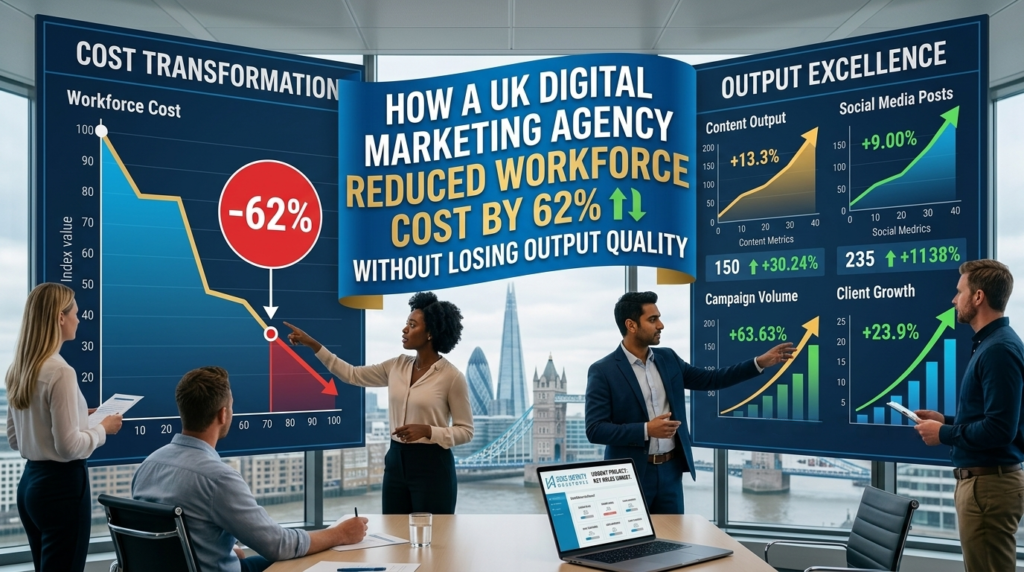
| Combined monthly workforce cost (2 roles) | £9,200 | £3,500 | –62% |
| Monthly saving | — | £5,700 | £68,400/yr |
| Content output (pieces per week) | 4 | 6 | +50% |
| Social posts per month (per platform) | 10 | 25 | +150% |
| New client accounts onboarded | 0 (capacity constrained) | 3 | Growth unlocked |
| Replacement events in 6 months | 1 (unplanned resignation) | 0 | Continuity maintained |
The 62 per cent cost reduction is the headline. For Dan, the bigger operational shift came from building an outsourced marketing team that could support growth without increasing local hiring costs. But the output volume increase is the number Dan talks about more. The content writer, AI-trained from Day 1, produced six pieces a week from the start, two more than the in-house predecessor was managing. The social media manager delivered 25 posts per platform per month versus the 10 the agency had been producing.
The £5,700 monthly saving was reinvested into paid search for the agency’s own client acquisition. Within 60 days of that investment starting, three new accounts were signed. Dan’s words: ‘We grew because we stopped spending growth capital on headcount that didn’t need to cost what it was costing us.’
FAQs
How do marketing agencies reduce staffing costs without losing quality?
The two levers are role structure and model. Not every role needs to be in-house. Execution roles, content, SEO, and social media are defined by output, not presence. Shifting those to a managed remote model with proper accountability infrastructure reduces the cost stack significantly without changing what gets produced. The quality floor is set by the hiring process, not by whether the person sits in the building.
What is the typical cost saving when switching to remote outsourced resources?
For a mid-level execution role in the UK, the true all-in cost typically runs between £4,000 and £5,200 a month. A managed remote equivalent for the same role usually costs £1,500 to £2,000 a month, all inclusive. The monthly saving per role is typically £2,500 to £3,200. Across two roles over a year, that’s £60,000 to £77,000 that stays in the business.
How do you onboard an outsourced resource to an agency’s brand guidelines?
Three documents do most of the work: a brand voice guide, a content example library, and a brief template. The resource follows the brief template for every piece from Day 1. Output gets reviewed daily in the first two weeks, and corrections are fed back in writing, which strengthens the brief over time. Most resources reach full brand alignment within two to three weeks when the materials are clear and specific.
What does an AI-trained content writer produce for a marketing agency?
An AI-trained content writer working in Notion AI, Surfer SEO, and ChatGPT typically produces four to six long-form SEO pieces per week, compared to three to four from a manual writer. Surfer SEO scores tend to be higher because the tool flags optimisation gaps during drafting. Research is faster. Outlines are built from a prompt workflow rather than from scratch. The quality is consistent, and the volume is higher.
Can outsourced resources handle multiple clients simultaneously?
Yes, and most managed remote resources do. The key is clear workload allocation and an output target that reflects the combined client load rather than treating each account independently. A content writer handling five client accounts with clearly defined weekly output per account produces more reliably than one handling the same load informally. The brief template and daily log keep multiple streams organised and visible.
Considering the same shift? We’ll build your cost model in one conversation.
ZeusInfinity Workforce will map the true cost of your current headcount and show you exactly what the savings look like for your team structure, before you commit to anything.