

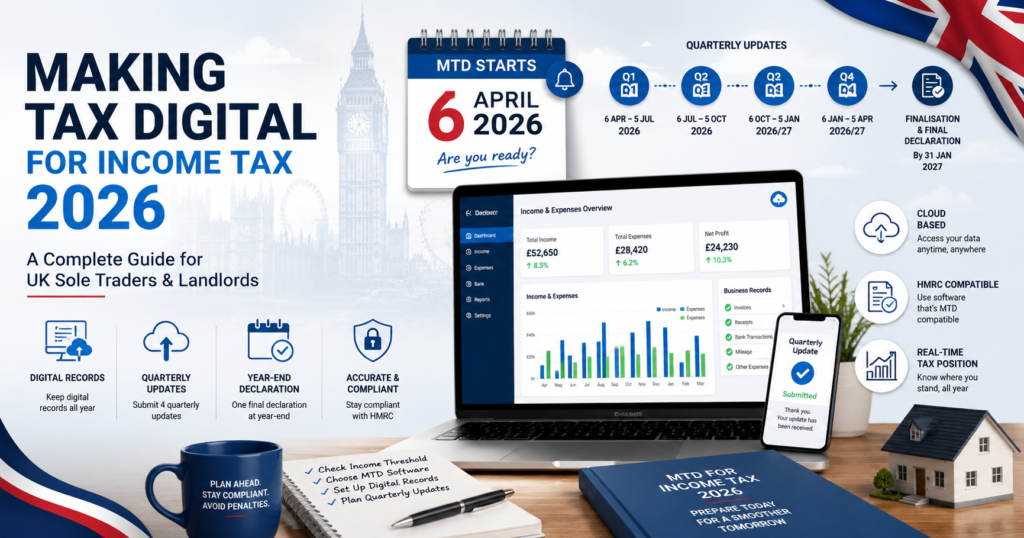
Making Tax Digital for Income Tax: What Every UK Sole Trader and Landlord Needs to Know in 2026
If you’re a sole trader or landlord in the UK, 2026 is the year your relationship with HMRC changes for good. Making Tax Digital for Income Tax. MTD live, it’s mandatory for hundreds of thousands of taxpayers starting this April, and it fundamentally rewrites how you’ll report income for the rest of the decade.
The era of rushing to submit one Self-Assessment return in January is over. Starting on 6 April 2026, qualified taxpayers are required to maintain digital records, utilize software approved by HMRC, and provide updates quarterly, along with a final declaration at year-end. If this seems overwhelming, you’re not the only one. This handbook explains precisely the modifications, who will be impacted, and how to prepare in advance to avoid a backlog of deadlines.
What Is Making Tax Digital for Income Tax?
Making Tax Digital for Income Tax is HMRC’s initiative to move self-employed individuals and landlords away from paper-based, once-a-year tax filing and into continuous, digital compliance. Instead of submitting one Self Assessment return annually, taxpayers within scope must now:
• Keep digital accounting records throughout the year
• Use HMRC-compatible accounting software
• Submit four quarterly updates covering income and expenses
• Complete one Annual Finalisation and Final Declaration at year-end
In short, MTD replaces the “one and done” annual return with an ongoing, quarterly rhythm of reporting.
Why Is HMRC Introducing MTD Now?
HMRC’s stated goal behind the MTD Income Tax rollout is to close the UK’s tax gap — the difference between tax owed and tax actually collected, much of which HMRC attributes to avoidable errors rather than deliberate evasion. The reform is designed to:
• Reduce common tax errors caused by manual, end-of-year calculations
• Improve the accuracy of tax reporting across the board
• Digitise tax administration in line with other government services
• Give taxpayers a real-time picture of their tax position, rather than a once-a-year snapshot
• Phase out manual paper records entirely
The logic is straightforward, quarterly digital updates catch mistakes early, rather than letting a year’s worth of errors compound until January.
The MTD Rollout Timeline: Who’s In and When
The rollout is being phased in based on gross income, giving taxpayers (and their accountants) time to prepare. Here’s how it breaks down:
| Phase | Mandatory From | Income Threshold |
| Phase 1 | 6 April 2026 | Above £50,000 |
| Phase 2 | 6 April 2027 | Above £30,000 |
| Phase 3 | 6 April 2028 | Above £20,000 |
Your qualifying income is assessed using your most recent Self Assessment tax return. For example, a sole trader who reported £55,000 in gross income on their 2024/25 return will be required to start MTD from 6 April 2026 even though that figure is now two tax years old by the time the rule kicks in. This is exactly why understanding qualifying income under MTD matters so much, and why waiting until the deadline is close is a risky strategy.
Understanding “Qualifying Income” — The Most Misunderstood Part of MTD
Here’s where a lot of confusion creeps in: qualifying income is based on gross income, not profit.
Qualifying income includes gross income from:
• Self-employment
• UK property rental
It does not include:
• Salary
• Pension
• Investment income
• Dividends
• Savings interest
That distinction catches many taxpayers off guard. Consider a sole trader with £55,000 in turnover, £45,000 in expenses, and just £10,000 in actual profit. Because HMRC calculates the threshold on gross receipts rather than net profit, this taxpayer is still firmly inside MTD’s scope despite a comparatively modest profit margin. If you’re a landlord or sole trader running high-turnover, low-margin operations, don’t assume you’re safe just because your take-home profit sits under the threshold.
How the New Quarterly Filing Process Works
Instead of one annual return, MTD introduces a structured cycle of four quarterly submissions plus a year-end finalisation.
Each quarter, taxpayers submit:
• Income
• Expenses
• Supporting business records
Quarterly deadlines:
| Quarter | Period Covered | Due Date |
| Q1 | April – June | 7 August |
| Q2 | July – September | 7 November |
| Q3 | October – December | 7 February |
| Q4 | January – March | 7 May |
Once all four quarterly updates are submitted, taxpayers complete an Annual Finalization and Final Declaration, which calculates the final tax position for the year. Effectively, this process replaces the traditional Self Assessment return for anyone within MTD’s scope , meaning the old once-a-year rhythm disappears entirely for affected taxpayers.
Who Actually Needs to Comply?
Included in the current MTD rollout:
• Sole traders
• Landlords
• Individuals with mixed income (business and property combined)
Not currently included:
• Employees with no self-employment or rental income
• Pensioners
• Investors with no qualifying trade or property income
• Partnerships (for now)
• Anyone whose qualifying income sits below the relevant threshold
It’s worth flagging that partnerships may be brought into scope in a future phase, but they are explicitly excluded from the 2026–2028 rollout as it currently stands. If your income doesn’t clear the threshold for your phase, you’re not required to comply yet but thresholds are dropping every year, so this is worth revisiting annually rather than assuming you’re permanently exempt.
What This Means for Accountancy Firms
For accountancy firms, MTD isn’t just a software upgrade, it’s a shift in how client relationships work day to day. Previously, the pattern was simple: a client got in touch once a year, the return got prepared, and the job was done.
Under MTD, that annual touchpoint becomes a quarterly one. Firms now need to plan for:
• More frequent client communication, roughly every three months instead of once a year
• More regular bookkeeping reviews to keep records audit-ready
• More proactive follow-ups to chase missing records before deadlines
• Increased staffing capacity to handle a compressed, repeating cycle
• Restructured workflow management built around four recurring deadlines rather than one
In other words, MTD moves the entire profession from annual compliance to continuous compliance. Firms that treat this purely as a software swap rather than an operational overhaul, are likely to find themselves overwhelmed the moment Q1 deadlines start landing on the same week for dozens of clients.
1. What is Making Tax Digital (MTD) for Income Tax?
Making Tax Digital (MTD) for Income Tax is HMRC’s digital tax reporting system for self-employed individuals and landlords. Instead of filing one annual Self Assessment tax return, eligible taxpayers must keep digital records, use HMRC-compatible software, submit quarterly updates, and complete a year-end final declaration.
2. Who needs to comply with MTD for Income Tax?
MTD for Income Tax applies to:
- Sole traders
- UK landlords
- Individuals with both self-employment and property income
It does not currently apply to employees with only PAYE income, partnerships, or individuals whose qualifying income falls below the applicable threshold.
3. How many tax submissions will I need to make each year?
Under MTD, you’ll generally submit:
- Four quarterly updates
- One Annual Finalization
- One Final Declaration
This replaces the traditional once-a-year Self Assessment process for taxpayers within scope.
4. Do I need special software for MTD?
Yes. HMRC requires taxpayers within MTD to maintain digital records and submit updates using HMRC-compatible software. Paper records and manual submissions will no longer meet the requirements for affected taxpayers.
5. Can I still file a Self Assessment tax return?
If you’re required to comply with MTD for Income Tax, you’ll follow the MTD reporting process instead of submitting a traditional Self Assessment return. Taxpayers who are not yet within MTD will continue using Self Assessment until they become eligible.
6. What happens if I miss an MTD filing deadline?
Missing deadlines may result in penalties under HMRC’s points-based penalty system. Filing on time and maintaining accurate digital records can help you avoid penalties and interest charges.
7. Do landlords have to comply with Making Tax Digital?
Yes. Landlords with qualifying UK property income above the applicable threshold must comply with MTD for Income Tax and submit quarterly updates using compatible software.
8. How should I prepare for Making Tax Digital?
To prepare, you should:
- Confirm whether your qualifying income exceeds the threshold.
- Start maintaining digital records.
- Choose HMRC-compatible accounting software.
- Review your bookkeeping processes.
- Speak with your accountant well before your compliance date.
9. How will MTD affect accountants and tax advisors?
MTD increases the frequency of tax reporting, requiring accountants to manage quarterly submissions instead of annual filings. This means more regular client communication, ongoing bookkeeping support, and stronger workflow management throughout the year.
10. Does MTD for Income Tax change how much tax I pay?
No. Making Tax Digital changes how and when you report your income, not how your tax is calculated. Your tax liability is still determined under existing UK tax rules.