

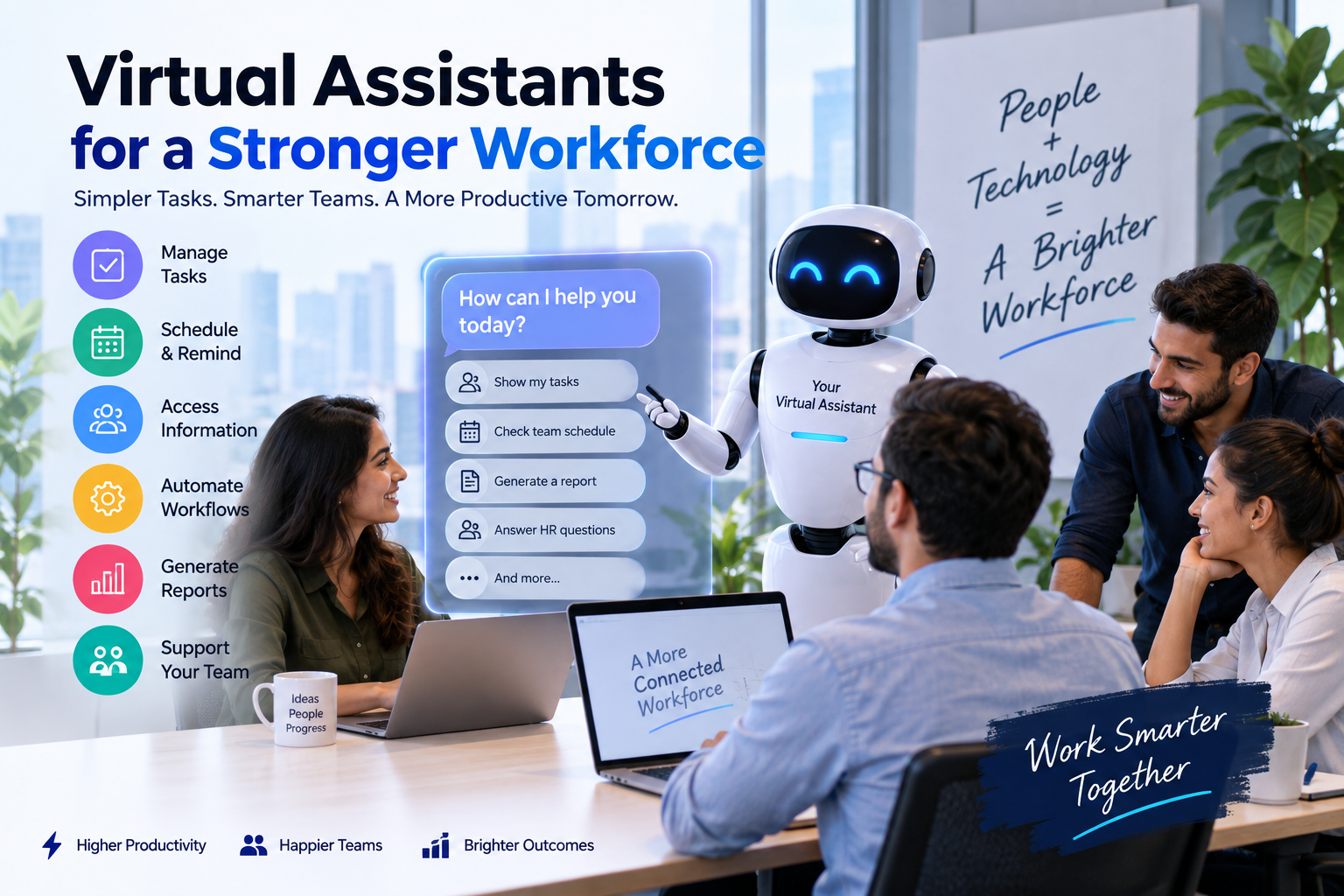
The way businesses operate is changing rapidly. Teams are becoming more distributed, companies are adopting automation, and employees are increasingly relying on digital tools to manage everyday work. One technology playing a major role in this transformation is the virtual assistant.
Modern virtual assistants are no longer limited to answering basic questions. With AI, automation, and integrations with business tools, they can help employees manage tasks, organize information, communicate with teams, and complete repetitive work faster.
What Is a Virtual Assistant?
A virtual assistant is a digital system designed to help users perform tasks through simple commands or conversations.
Depending on the platform, a virtual assistant can help with activities such as:
- Creating and assigning tasks
- Setting reminders
- Managing schedules
- Finding company information
- Preparing reports
- Sending notifications
- Organizing employee records
- Answering frequently asked questions
- Tracking project progress
- Automating repetitive processes
When connected with a workforce management platform, the assistant can become a central point for employees and managers to interact with different business functions.
Why Businesses Are Using Virtual Assistants
Employees often spend a significant amount of time switching between applications, searching for information, updating records, and completing administrative work.
A virtual assistant can simplify these activities by providing one conversational interface.
For example, instead of navigating through multiple screens, an employee could simply ask:
“Show me my tasks for today.”
A manager could ask:
“Which projects are currently delayed?”
An HR team member could request:
“Show employees whose attendance requires review.”
The assistant can retrieve the relevant information and present it immediately.
Automating Repetitive Work
One of the biggest advantages of virtual assistants is automation.
Many workplace activities follow predictable patterns. These can include daily reminders, task assignments, employee notifications, follow-ups, and reporting.
By automating these processes, businesses can reduce repetitive manual work and allow employees to focus on activities that require creativity, decision-making, and human interaction.
Better Task Management
Virtual assistants can also improve task management.
Employees can use conversational commands to create tasks, update their status, change deadlines, or check priorities.
Managers can quickly understand what their teams are working on without manually reviewing multiple dashboards.
This can help organizations maintain better visibility across projects and reduce missed deadlines.
Faster Access to Information
Employees often lose time searching through documents, emails, dashboards, and internal systems.
An AI-powered virtual assistant can act as a searchable interface for workplace information.
Instead of searching manually, employees can ask questions such as:
“What is our leave policy?”
“Show my pending approvals.”
“What tasks are assigned to the marketing team?”
“Give me a summary of this week’s project activity.”
Providing faster access to information can make everyday operations more efficient.
Supporting Remote and Hybrid Teams
Virtual assistants can be especially useful for remote and hybrid organizations.
When employees work from different locations, communication and coordination can become more complex.
A centralized assistant can help teams access the same information, receive reminders, monitor tasks, and stay updated regardless of where they are working.
This creates a more connected digital workplace.
Virtual Assistants and Workforce Management
When virtual assistants are integrated into workforce management platforms, their capabilities become even more powerful.
Employees can interact with workforce functions directly through conversation.
For example, a virtual assistant could help with:
Task Management:
Create, assign, update, and monitor tasks.
Attendance:
Check attendance records, working hours, and schedules.
HR Support:
Answer questions about policies, leave requests, and employee information.
Project Tracking:
Provide updates about milestones, deadlines, and project progress.
Notifications:
Automatically remind employees about important activities.
Reporting:
Generate summaries and insights from workforce data.
AI as a Workplace Assistant, Not a Replacement
The goal of virtual assistants is not simply to replace employees.
Their biggest value comes from helping people work more efficiently.
AI assistants can handle repetitive digital activities while employees focus on strategy, customer relationships, creative work, problem-solving, and other activities that benefit from human judgment.
The most effective workplaces will likely combine human expertise with intelligent automation.
The Future of Virtual Assistants in the Workplace
Virtual assistants will continue becoming more integrated with business systems.
Instead of employees manually operating dozens of applications, they may increasingly interact with business software through natural conversations.
A single assistant could eventually help employees manage tasks, communication, documents, projects, reports, schedules, and other operational activities from one interface.
For businesses, this represents an opportunity to simplify workflows while creating a more productive and connected workforce.
Conclusion
Virtual assistants are becoming an important part of modern workforce technology.
By combining AI, automation, workforce data, and conversational interfaces, businesses can simplify everyday operations and give employees faster access to the tools and information they need.
For organizations building the workplace of the future, virtual assistants can become a powerful layer connecting people, processes, and technology.