

Freelancing or Outsourcing: Which Is Better for Businesses in 2026?
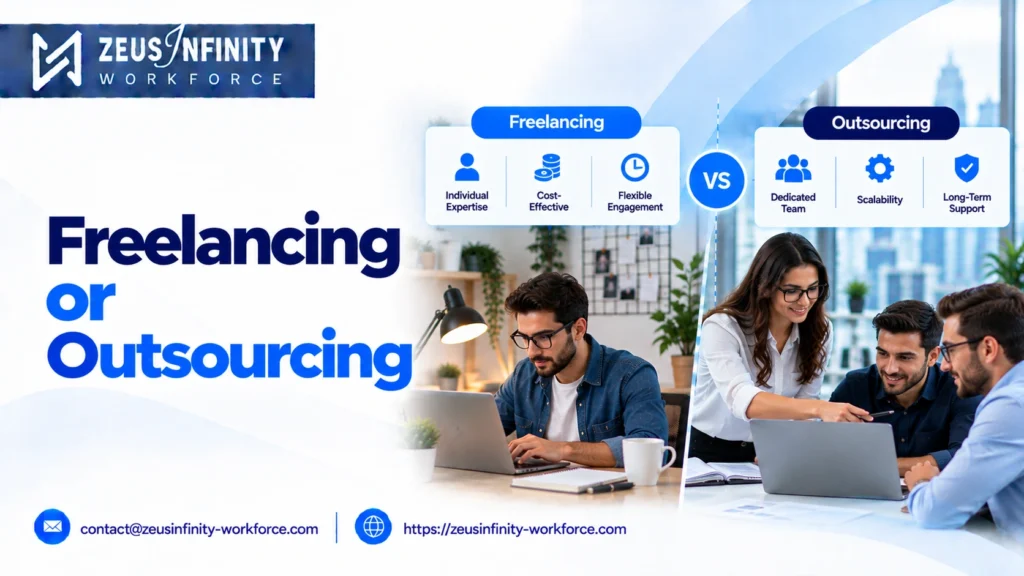
Businesses today have more options than ever when they need additional talent, specialized expertise, or support for ongoing work. Instead of hiring every role internally, companies can work with freelancers or use an outsourcing model. This creates an important question for business owners:
Freelancing or outsourcing-which is the better option for your business?
Both models can help businesses access external talent. However, they work differently. Freelancing generally involves hiring an individual professional to complete specific tasks or projects. Outsourcing typically involves transferring specific business functions or ongoing responsibilities to an external provider or team. For businesses that need a single specialist for a short-term project, freelancing can be practical. But when a company needs multiple skills, ongoing support, structured management, scalability, and continuity, outsourcing can offer a broader business solution.
This guide compares freelancing vs outsourcing, explains the difference between the two models, and examines when businesses may benefit from choosing an outsourcing partner.
What Is Freelancing?
Freelancing is a work arrangement in which an independent professional provides services to one or more clients without becoming a traditional full-time employee of the business.
A freelancer may specialize in:
- Content writing
- Graphic design
- Web development
- SEO
- Social media management
- Copywriting
- Accounting
- Video editing
- Software development
- Digital marketing
- Virtual assistance
Businesses commonly hire freelancers for specific projects, defined tasks, or specialized expertise.
For example, a company launching a new website might hire a freelance web designer for the project. Similarly, a business might hire a freelance content writer to produce a specific number of blog posts each month.
Freelancing can therefore provide flexibility when the requirement is clearly defined and does not justify building a permanent internal position.
What Is Outsourcing?
Outsourcing is a business model in which a company transfers specific functions, processes, or responsibilities to an external service provider. Unlike hiring one freelancer, outsourcing can provide access to an external team with multiple specialists and a defined delivery structure.
Businesses can outsource:
- IT services
- Software development
- Digital marketing
- SEO
- Content writing
- Finance and accounting
- Customer support
- Recruitment
- Administrative work
- Data entry
- Virtual assistance
- Human resources
- Back-office operations
For businesses looking for broader workforce solutions, ZI Workforce services provide access to different outsourcing capabilities.
The important distinction is that outsourcing is generally designed around a business function, service, or ongoing responsibility, rather than simply hiring an individual for a task.
What Is the Difference Between Freelancing and Outsourcing?
The key difference between freelancing and outsourcing is the structure of the relationship. A freelancer is typically an individual professional who works independently for a client. An outsourcing provider can provide a team, specialists, management, processes, and ongoing operational support.
In simple terms:
Freelancing = hiring an individual.
Outsourcing = transferring specific work or functions to an external provider or team.
The exact arrangement can vary. Some freelancers work on long-term contracts, while some outsourcing providers handle short-term projects. However, the distinction becomes clearer when comparing team structure, management, scalability, and responsibility.
Freelancing vs Outsourcing: Key Differences
| Factor | Freelancing | Outsourcing |
|---|---|---|
| Resource | Usually one person | External provider or team |
| Scope | Often specific tasks or projects | Can cover complete functions |
| Expertise | Usually one specialist | Multiple specialists can be available |
| Management | Client often manages freelancer directly | Provider can manage delivery |
| Scalability | Requires finding additional freelancers | Team capacity can often be expanded |
| Continuity | Can depend on one person | Can be supported by a broader team |
| Accountability | Individual-based | Provider/team-based |
| Best for | Specific projects and tasks | Ongoing or broader business functions |
| Team access | Limited to individual | Multiple roles may be available |
| Processes | Freelancer-dependent | Can include structured processes |
| Long-term support | Depends on freelancer | Often designed for ongoing support |
This is why the freelancer vs outsourcing decision should not be based only on hourly rates.
Businesses should also consider how much management, expertise, continuity, and scalability they need.
Freelancing vs Outsourcing: Cost Comparison
Cost is one of the first things businesses consider when comparing freelancing vs outsourcing.
Freelancing may appear more affordable when a company needs a small amount of work from one specialist.
For example, hiring a freelance writer for five articles may require only a defined project fee.
However, costs can become more complicated when a company needs several freelancers.
Imagine a company needs:
- SEO
- Content writing
- Social media
- Graphic design
- Paid advertising
The business may need to find and manage five different freelancers.
That can create additional costs related to:
- Recruitment
- Coordination
- Communication
- Project management
- Quality control
- Contract management
- Scheduling
With outsourcing, these functions may be handled through one external provider or coordinated team.
Therefore, when comparing outsourcing vs freelancing, businesses should evaluate the total cost of obtaining and managing the required capability, rather than simply comparing individual hourly or project rates.
Flexibility: Freelancing vs Outsourcing
Freelancing can provide significant flexibility.
A business can hire a freelancer for:
- A one-time project
- A short-term requirement
- A specific skill
- Temporary workload
- Specialized expertise
However, outsourcing can also provide flexibility while offering a broader resource structure.
For example, an outsourced team may allow a company to increase support when workload increases and adjust the scope when business requirements change.
This can make outsourcing particularly useful for businesses whose requirements are not limited to one individual skill.
Expertise and Specialist Access
A freelancer typically brings expertise in a particular area.
That can be valuable when the business knows exactly what it needs.
For example:
“We need a technical SEO specialist for a website audit.”
Hiring a freelance SEO professional could make sense.
But consider a broader requirement:
“We need SEO, content, social media, paid advertising, design, and marketing analytics.”
Managing several freelancers can become more complicated.
An outsourcing provider may be able to provide access to a team containing different specialists.
This is one of the reasons outsourcing services can be attractive to businesses with broader operational requirements.
Accountability: Freelancer vs Outsourcing Provider
Accountability is another important difference in the freelancing or outsourcing decision.
When working with a freelancer, the business generally communicates directly with the individual responsible for the work.
That can be straightforward, but it can also mean that the client is responsible for:
- Assigning tasks
- Following up
- Reviewing work
- Managing deadlines
- Coordinating projects
- Finding replacement support if the freelancer becomes unavailable
An outsourcing provider can potentially take greater responsibility for delivery management.
Depending on the agreement, the provider may manage:
- Team members
- Work allocation
- Quality control
- Deadlines
- Reporting
- Communication
- Resource replacement
This can reduce the amount of operational coordination required from the client.
Scalability: Why Outsourcing Can Be More Practical
Scalability is one of the strongest reasons businesses consider outsourcing vs freelancing.
A company may start with one freelancer and later need additional support.
If the business continues adding freelancers, it may eventually have to manage multiple independent professionals.
For example:
Freelancer 1 → SEO
Freelancer 2 → Content
Freelancer 3 → Social Media
Freelancer 4 → PPC
Freelancer 5 → Design
The company now has five external relationships to manage.
With outsourcing, the same requirements may potentially be handled through one external team.
This can simplify:
- Communication
- Management
- Reporting
- Work allocation
- Quality control
- Scaling
For growing businesses, this team-based structure can make outsourcing more suitable for ongoing requirements.
Continuity and Business Operations
Business continuity is another consideration.
If a freelancer becomes unavailable, the business may need to find another professional who understands the project.
That can create delays.
An outsourcing provider with a broader team may have the ability to allocate another qualified resource when circumstances require it.
This does not mean every outsourcing provider automatically guarantees continuity. Businesses should verify the provider’s staffing model, backup processes, service-level commitments, and replacement procedures before signing an agreement.
Still, the team-based nature of many outsourcing models can provide a different level of operational continuity compared with depending on one individual freelancer.
Management Requirements
Freelancing can sometimes transfer the work to an external professional without transferring much of the management responsibility.
The business may still need to:
- Assign tasks
- Set deadlines
- Review deliverables
- Follow up
- Coordinate work
- Manage communication
With an outsourcing model, the provider may take responsibility for managing the external team.
This can be particularly useful when the business does not want to spend significant internal time coordinating several external professionals.
Is Outsourcing Better Than Freelancing for Businesses?
There is no universal answer because the right model depends on the business requirement. However, outsourcing can be more suitable than freelancing when a business needs ongoing support, multiple specialists, structured management, scalability, and broader operational coverage.
Outsourcing may be particularly useful when a company:
- Needs multiple specialists
- Requires ongoing support
- Wants a managed external team
- Expects workload to grow
- Does not want to coordinate multiple freelancers
- Needs defined processes
- Requires consistent reporting
- Wants greater continuity
- Needs to outsource an entire business function
Freelancing can remain useful for smaller, specialized, or short-term requirements.
The key is to match the model with the complexity of the work.
What Are the Benefits of Outsourcing?
The benefits of outsourcing extend beyond simply accessing external workers.
Access to a Team
Instead of depending on one individual, businesses can access multiple specialists through an external provider.
Scalability
Businesses can potentially expand the scope or team size as requirements change.
Reduced Recruitment Burden
The company does not necessarily have to independently find and recruit every specialist.
Structured Management
An outsourcing provider may manage team members, workflows, quality, and reporting.
Broader Expertise
Businesses can access multiple areas of expertise without building every role internally.
Business Continuity
A team-based model may provide additional continuity compared with depending entirely on one external professional.
Focus on Core Activities
Outsourcing non-core activities can allow internal teams to focus more closely on strategic and customer-facing responsibilities.
Potential Operational Efficiency
A structured outsourcing model can combine people, processes, management, and specialist expertise.
When Should a Business Choose Freelancing?
Freelancing can be suitable when:
- The project is clearly defined
- Only one specialist is needed
- The work is temporary
- The business has strong internal project management
- The requirement is relatively small
- The business wants direct communication with an individual
- There is no need for a larger team
For example, hiring a freelance graphic designer to create a set of marketing materials can be a straightforward arrangement.
When Should a Business Choose Outsourcing?
Outsourcing may be more appropriate when:
- The work is ongoing
- Multiple specialists are required
- The business wants a managed team
- Workload is expected to increase
- The company wants structured reporting
- Internal management capacity is limited
- Business continuity is important
- The function can be clearly transferred to an external provider
For example, a company may outsource its entire digital marketing function instead of separately managing freelance SEO, content, social media, and PPC professionals.
Businesses considering international outsourcing can also explore outsourcing to India as one potential operating model.
Freelancing vs Outsourcing for Small Businesses
Small businesses often have limited budgets and limited management capacity.
At first, freelancing may appear attractive because the company can hire someone for a specific task without establishing a larger arrangement.
However, as the business grows, its requirements can become broader.
A small business might initially need a freelance content writer.
Later, it may also need:
- SEO
- Social media
- Web development
- Graphic design
- Virtual assistance
- Finance support
At this stage, continuously adding freelancers can create management complexity.
An outsourcing model can potentially consolidate several requirements through one provider.
For small and growing businesses, this can make outsourcing worth evaluating as an alternative to managing multiple freelancers.
Freelancing vs Outsourcing for Long-Term Work
Long-term work requires more than simply finding someone who can complete the task.
Businesses should consider:
- Continuity
- Knowledge retention
- Performance management
- Communication
- Scalability
- Backup resources
- Reporting
- Quality control
These factors can make an outsourced team attractive for long-term business functions.
For example, a company outsourcing finance and accounting may need continuous support rather than a freelancer completing one accounting project.
Similarly, a company outsourcing digital marketing may need SEO, content, social media, and analytics every month.
In these situations, outsourcing vs freelancing becomes a question of operational structure rather than simply price.
Freelancing vs Outsourcing for Digital Marketing
Digital marketing is a good example of where the difference becomes clear.
A business could hire:
- One freelance SEO specialist
- One freelance content writer
- One freelance social media manager
- One freelance PPC specialist
- One freelance designer
Alternatively, it could use an outsourced digital marketing team.
An outsourced model can potentially bring these specialists together under one coordinated structure.
Businesses evaluating digital marketing support can explore ZI Workforce’s digital marketing services.
Businesses can also use specialist support such as SEO expert hiring services or content writing services depending on their requirements.
Freelancing vs Outsourcing for IT and Development
The same comparison applies to technology.
A company may hire one freelance developer for a specific feature.
But larger requirements may involve:
- Front-end development
- Back-end development
- UI/UX
- Testing
- DevOps
- Project management
- Maintenance
Managing multiple freelancers can become complicated.
An outsourced development team can potentially provide several capabilities within one delivery structure.
Businesses considering technology outsourcing can explore IT outsourcing services and developer hiring solutions.
Common Mistakes When Choosing Between Freelancing and Outsourcing
Choosing Only Based on Price
A lower hourly rate does not necessarily mean a lower total business cost.
Consider management time, coordination, quality control, replacement requirements, and the number of external resources required.
Hiring Multiple Freelancers Without a Management Plan
Multiple freelancers can create communication and coordination challenges.
Outsourcing Without Defining Responsibilities
Businesses should clearly document:
- Scope
- Deliverables
- KPIs
- Deadlines
- Reporting
- Communication
- Ownership
- Escalation procedures
Ignoring Scalability
Consider whether the chosen model will still work when the business doubles its workload.
Failing to Evaluate Continuity
Ask what happens if the individual or team responsible for the work becomes unavailable.
Focusing Only on Individual Skills
Businesses should evaluate the entire operating model, not just whether a person or provider has the required skill.
How to Choose the Right Outsourcing Partner
If outsourcing appears to fit the business requirement, evaluate potential providers carefully.
Review Relevant Experience
Look for experience with similar services, industries, business sizes, and operational requirements.
Understand the Team Structure
Ask whether you will receive one resource or access to a broader team.
Evaluate Communication
Determine how frequently the provider will communicate and how issues will be escalated.
Review Service Scope
Understand exactly what is included in the agreement.
Check Scalability
Ask how the provider handles increased workloads and additional requirements.
Understand Reporting
Make sure you will receive clear and useful performance information.
Review Data Security
If the provider will access confidential business or customer information, understand its security and data-handling processes.
Clarify Ownership
Ensure that important accounts, data, intellectual property, and business assets are appropriately controlled.
Freelancing or Outsourcing: A Simple Decision Framework
Use this framework when deciding between the two models.
Choose Freelancing If:
You need one person
Consider Outsourcing If:
You need a team + ongoing work + multiple skills + structured management.
For example:
Logo design for a new campaign → Freelancer
Monthly SEO + content + social media + reporting → Outsourcing
One website bug → Freelancer
Continuous software development and maintenance → Outsourcing
One-time market research project → Freelancer
Ongoing lead generation operation → Outsourcing
This framework can help businesses determine whether they need an individual professional or a broader external workforce solution.
Conclusion
When comparing freelancing or outsourcing, the right choice depends on the type of work a business needs. Freelancers can be useful for short-term projects, individual tasks, or situations where a company needs one specific skill for a limited period. However, as business requirements become ongoing, more complex, or involve multiple functions, outsourcing offers a more structured solution.
Outsourcing provides businesses with access to a wider talent pool, dedicated teams, specialist expertise, ongoing support, scalability, and professional management without the need to build and manage every role internally. Instead of coordinating multiple freelancers and handling separate workflows, businesses can work with an outsourcing partner that takes responsibility for delivering a defined function or set of services.
For growing businesses, this makes outsourcing more than a cost-saving strategy. It can become a practical way to expand capacity, maintain continuity, improve operational efficiency, and access expertise without increasing the complexity of in-house hiring.
For businesses with broader and ongoing requirements, this team-based approach can make outsourcing a practical alternative to managing multiple individual freelancers. If your business is evaluating external workforce solutions, explore ZI Workforce services to see how outsourcing can support different business functions.
Freelancing usually involves hiring an independent individual for specific work, while outsourcing generally involves transferring a business function, process, or ongoing responsibility to an external provider or team.
The appropriate model depends on the business requirement. Freelancing can suit defined projects and individual specialist needs, while outsourcing can be more suitable for ongoing work, multiple specialists, structured management, and scalability.
Not necessarily. The cost depends on the scope, workload, expertise, management requirements, and pricing model. Businesses should compare the total cost of delivering the required work rather than only hourly rates.
The benefits of outsourcing can include access to a team, specialist expertise, scalability, reduced recruitment requirements, structured management, operational continuity, and additional capacity.
A business may consider outsourcing when it needs ongoing support, multiple specialists, a managed team, broader operational coverage, or greater scalability.
Yes. A business can use freelancers for specialized one-off projects while outsourcing ongoing business functions to an external provider.
Yes. Small businesses can outsource specific functions when they lack internal expertise, resources, or capacity. The scope should be aligned with their budget and operational requirements.
Businesses may choose outsourcing to access specialist expertise, expand capacity, reduce recruitment requirements, support ongoing operations, and scale certain functions without building every capability internally.
Businesses should evaluate cost, scope, expertise, team structure, communication, scalability, data security, accountability, service levels, and ownership before selecting an outsourcing provider.