

From 6-Week Hiring Delay to Deployed in 11 Days: How a UK SaaS Startup Used Rapid Hiring Solutions
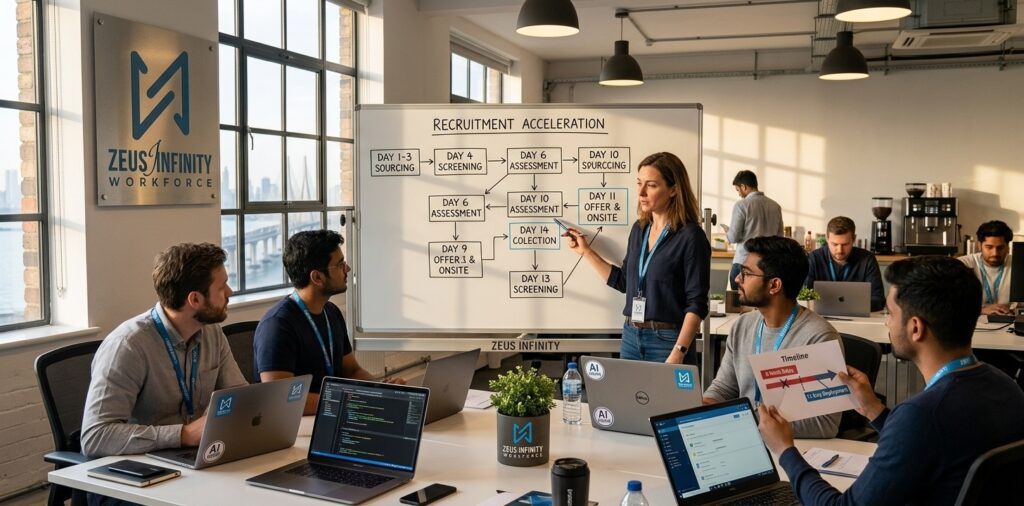
Twenty people, four live projects, and a resignation letter on a Monday morning
Priya runs a 20-person SaaS startup based in Leeds. The product is a client reporting platform used by professional services firms. Operations are tight, not understaffed, but lean. Every role matters. The situation highlighted why many growing SaaS companies are turning to rapid hiring solutions when critical operational roles suddenly become vacant.
On a Monday in late autumn, her Operations Coordinator, Tom, handed in his notice. Two weeks. He’d been offered a senior position elsewhere and was taking it. No bad blood-just the worst possible timing.
Tom was central to four live client onboarding projects. He owned the daily reporting workflow, managed the task tracking system, and was the primary contact for client-side project coordinators. His institutional knowledge, which tools were configured how, which clients needed specific handling, which processes were informal but critical, wasn’t written down anywhere.
Two weeks to hand over everything. Four client projects at risk of delay. And a standard hiring process that Priya knew from experience took six to eight weeks from brief to offer accepted.
A gap that the standard hiring timeline couldn’t bridge

Priya had hired through traditional routes before. The last ops coordinator took seven weeks from job posting to start date, and that was considered fast. A recruitment agency had been involved, multiple rounds of interviews, a reference check, and a notice period on the candidate’s side that added another month.
She’d also tried a freelancing platform once, for a different role. The experience was poor. Misaligned skills, inconsistent communication, and no accountability structure beyond the platform’s message thread. She’d had to let that person go after six weeks and essentially start again.
What she needed was someone who could start in under two weeks, work to a structured daily accountability framework, and be genuinely operational on client accounts within the first few days. That didn’t fit the standard hiring model. And it didn’t fit the freelancing model either. Priya needed a structured deployment process with accountability, communication standards, and operational continuity not just temporary freelance coverage or ad-hoc fast remote staffing support.
Eleven days from brief to operational: how the deployment actually ran
| Day | What Happened |
| Day 1 | Requirements call-45 minutes. Role responsibilities, tool environment (Notion, Asana, Google Workspace), client account context, and output targets defined. Multi-channel sourcing began the same afternoon. |
| Day 3 | First candidate profiles shared. AI-assisted screening had filtered the initial pool. Three candidates cleared the communication and role-fit criteria. |
| Day 5 | Rubric-based skill evaluations completed. All three candidates submitted a real-world ops task-a structured daily report based on a sample data set. Two cleared the scoring threshold. |
| Day 6–7 | Priya conducted interviews with both candidates. One stood out clearly-strong Notion skills, sharp written communication, directly relevant experience in SaaS client coordination. |
| Day 8 | Candidate confirmed. greytHR onboarding begun-NDA, compliance documentation, and data handling agreement. |
| Day 10 | System access provisioned via credential vault. Productivity monitoring installed. Tool walkthroughs completed. Brand and client context documents shared. |
| Day 11 | Operational. Daily task log submitted by 9am. First client reports reviewed and approved by midday. |
Tom’s last day was Day 10. The handover and the onboarding ran in parallel across his final three working days. By the time he left, the new resource had been through every live project, met (via video) the key client contacts, and had produced two daily reports that Priya had approved without revisions.
What the numbers looked like, compared to the previous hiring experience
| Metric | Before | After | Change |
| Time to deployment | 6–7 weeks (previous hire) | 11 days | –83% |
| Monthly resource cost | £3,400 (in-house, true all-in) | £1,800 (managed) | –47% |
| Client project delays | 4 at risk | 0 | Zero disruption |
| Days without ops coverage | 35+ (standard process) | 0 | Seamless transition |
| AI tool training (Notion, Asana) | Not included in-house | Completed before Day 1 | Immediate productivity |
The zero client project delays are the outcome Priya references most. ‘We came within days of a situation where four clients would have noticed something was wrong. That would have been damaging. The speed of the deployment is what prevented it.’
The monthly cost saving of £1,600 was also material for a 20-person startup, watching every overhead carefully. Over twelve months, that’s £19,200 back into the business, from a role that wasn’t originally intended to be a cost-saving exercise at all. It became one.
Questions SaaS founders ask about urgent hiring needs
How quickly can a managed outsourcing company deploy a resource?
With a structured rapid deployment model, a resource can be operational in 10 to 14 days from the initial requirements call. That timeline covers multi-channel sourcing, AI-assisted screening, rubric-based evaluation, client validation interviews, compliance onboarding, system setup, and tool configuration. The key is that all these stages run concurrently rather than sequentially, which is how the standard 6 to 8 week hiring process gets compressed into under two weeks.
What is the fastest way to hire an operations coordinator in the UK?
The fastest, most reliable route is a managed outsourcing model with a pre-built talent pipeline and a structured deployment process. Traditional recruitment takes 4 to 8 weeks from job brief to start date. A managed model with active candidate pools across multiple channels can shortlist qualified candidates within 2 to 3 days and deploy within 11 to 14 days. For urgent operational gaps, that’s often the only option that bridges the timeline without a significant period of uncovered capacity.
How do you handle urgent hiring needs without using expensive recruitment agencies?
The managed outsourcing model removes the agency fee entirely-it’s included in the monthly resource cost rather than charged as a separate placement fee of 15 to 20 per cent of salary. For an urgent hire, that means no upfront fee and no six-week delay. The cost savings are immediate. The speed advantage is the more important factor when a role is operationally critical and cannot sit open without a business impact.
What happens if a key employee resigns suddenly?
The managed model changes the risk profile significantly. With a replacement guarantee built in, if the deployed resource doesn’t work out or leaves, a replacement is found and deployed at no additional cost and without restarting the full recruitment cycle. For a business where the role is operationally critical, that continuity guarantee removes the single biggest risk of a managed remote arrangement: that the transition could need to be repeated.
How does ZeusInfinity Workforce’s rapid deployment process work?
The process has six stages that run in parallel rather than in sequence: requirements mapping on Day 1, multi-channel sourcing beginning the same day, AI-assisted screening within 48 hours, rubric-based skill evaluation by Day 4 to 5, client validation interviews on Day 6 to 7, and compliance onboarding and system setup completed by Day 10 to 11. Every stage is run simultaneously where possible, which is how a process that typically takes 6 weeks gets done in under 2.
Facing an urgent hiring need? We can begin sourcing within 24 hours of your brief.
Tell ZeusInfinity Workforce the role and the timeline. We’ll show you how fast we can move-and what the resource will look like before you commit to anything.