

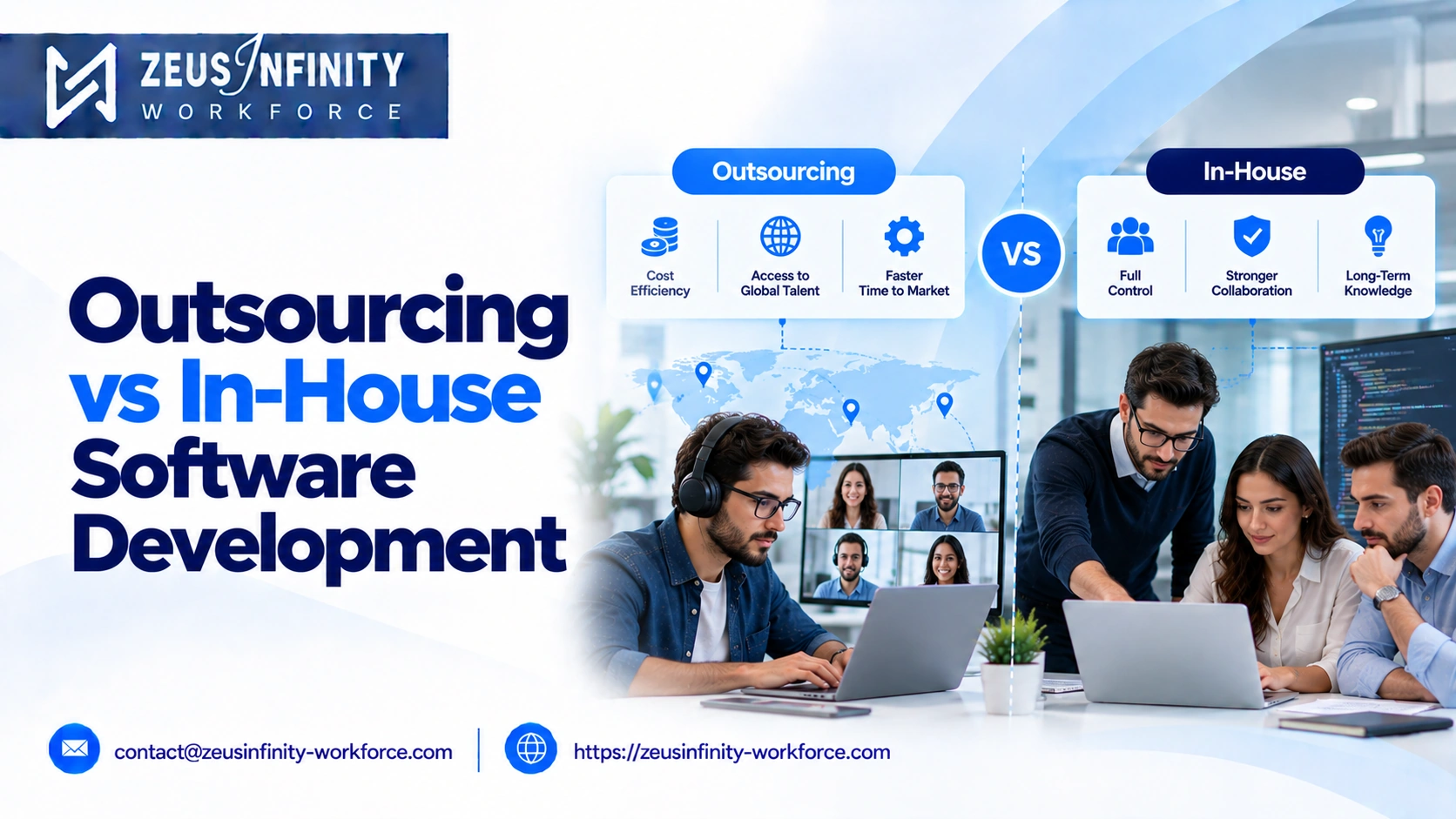
Outsourcing vs In-House Software Development: Which Wins on Cost, Speed and Accountability in 2026/27?
Outsourcing vs in-house software development in 2026/27 is the choice between a full-time managed offshore team working exclusively for you (at ~65% of the 1.55× all-in UK hire cost, with a measured 25%+ quarterly uplift) and hiring employees locally (higher all-in cost, 8–14 weeks to hire, accountability via an already-loaded manager).
Compare | 8 min read | By Deepika Solanki, Ops Lead — Workforce Deployment & Process Optimisation | Published 23 Sep 2026 | Updated 23 Sep 2026 | Tax year: 2026/27
- Cost truth (2026/27): UK in-house = base salary × 1.55. A managed outsourced role runs ~65% of that — 30–40% lower all-in, not 70–80%. The compound comes from fewer roles needed next quarter.
- Speed: In-house hire to productive start 8–14 weeks; ZI managed deployment 10–14 days from brief sign-off via 6-stage hiring.
- Accountability: In-house relies on a line manager; outsourcing via ZI gives a 3-Layer Transparency Framework (monitoring + daily reporting + supervisor QA) plus replacement guarantee.
- When to choose in-house: Deep domain co-location, regulated on-site pairing, or where headcount already exists and enablement (Model 02) fits better.
- First-party proof: ZI daily reporting 60 → <10 min per person via prompts alone; outbound verification at <2% bounce with zero subscription — same enablement motion applied to dev workflows.
Where this sits: See In-House vs Outsourced (pillar) and the Workforce hub. Accountability terms: Guarantees. Lateral: Benefits of Outsourcing IT Services. Cost your own delta: Employee Cost Calculator.
What do we actually mean by outsourcing vs in-house?
Outsourcing here means a full-time, managed, AI-enabled team on ZI’s payroll working exclusively for you; in-house means employees on your payroll in your office — the economic shapes are different, not just the locations. ZI Model 01 is not a contractor marketplace or a turnkey project vendor. Staff are recruited via a six-stage process, supervised, QA’d, reported daily and continuously enabled by ZI’s tech layer (prompts first, small utilities where they pay). Client data stays in client systems, governed by NDA/DPA before day one, and tooling built to make the workforce better stays ZI’s IP — you get the benefit as a service, with the accumulated library included. In-house is ownership: you carry recruitment, HR, supervision, equipment, onboarding and attrition risk, and improvement depends on whatever budget and bandwidth your managers have left. The question that decides most deals is not price but: “Who is responsible for making this team better next year than it is today?” No traditional category has an answer; ZI’s four-layer stack does.
Context on why this decision is peaking: McKinsey notes most companies still capture only a fraction of AI’s potential productivity benefit, with scaled adoption lagging despite heavy experimentation (McKinsey Global Survey on AI, 2024, McKinsey — The state of AI, updated 13 Mar 2024). The gap between what AI makes possible per person and how teams actually work day to day is the space this comparison lives in. Gartner’s $5.61 trillion IT spending forecast for 2025 (+9.8% YoY) frames the same pressure from the spend side (Gartner, 15 Oct 2024).
Which wins on cost in 2026/27 — and how large is the delta?
Outsourcing wins on all-in cost; the honest delta is 30–40% on day one, compounding via Layers 2–4. Never use base salary for comparison. A UK hire’s true cost is ~1.55× base: direct costs ~33% (NICs ~15%, pension ~3%, paid leave ~9%, insurance/compliance ~2%, benefits ~4%) and indirect ~22% (recruitment amortised ~5%, HR/payroll ~3%, supervision ~6%, equipment/software ~3%, onboarding ~2%, attrition buffer ~3%). ZI managed cost sits at ~65% of that true cost. That is the figure the deck and this site stand behind; “up to 80%” is an attention hook only.
| Role Example (2026/27) | UK Base Salary | UK True All-In (×1.55) | ZI Managed Outsourced | Delta |
|---|---|---|---|---|
| MERN Full-Stack (£48k band) | £4,000/mo | ~£6,200/mo | £2,300–£3,000/mo | −52% to −63% |
| Node / Next.js Mid (£42k) | £3,500/mo | ~£5,425/mo | £1,800–£2,600/mo | −52% to −67% |
| QA Engineer (£32k) | £2,667/mo | ~£4,134/mo | £1,200–£1,800/mo | −56% to −71% |
| WordPress / Shopify (£30k) | £2,500/mo | ~£3,875/mo | £1,400–£2,200/mo | −43% to −64% |
Tool costs not in table: Layers 2–4 compound. Example first-party: ZI’s outreach verification owned build replaced £40–£80/month subscription and holds <2% bounce; internal reporting 60 → <10 min — saved supervisor hours are not in the 1.55× but are real.
Beyond the rate, outsourcing removes re-recruitment cost via the replacement guarantee. In-house attrition triggers the 22% indirect load again (re-hire fee, vacancy gap, ramp). Outsourced attrition is ZI’s problem — coverage, not apology. Where in-house can be cheaper is at very small, stable scope where a single senior owns an already-shaped codebase and change volume is low — then supervision overhead is minimal and the 1.55× is overstated. That is a narrow window.
Which wins on speed to value?
Outsourcing wins to first productive commit; in-house can win to deep context — sequence matters. A UK hire runs 8–14 weeks before steady output: sourcing, interviews, offer, notice period (often 4–8 weeks for developers), onboarding. ZI deployment is 10–14 days from signed role brief, but treat the number as normal now — lead with mechanism: six stages, work-sample tasks, supervised QA. First sprint value comes faster outsourced. Deep domain context — your customers’ edge cases, your legacy decisions — accumulates faster in-house when the person sits beside product. The fastest compound is phased: deploy one managed role now for throughput, run your in-house pipeline in parallel, and let the 90-day review decide expansion. That avoids the common trap: hiring slowly for speed.
Which wins on accountability and quality?
Outsourcing via ZI wins on system accountability; in-house wins on proximity accountability — system scales. In-house accountability is a manager — often the same manager who is already at capacity. ZI accountability is a system: Layer 1 active/idle and app tracking with snapshots, Layer 2 start/end-of-day logs, Layer 3 supervisor QA and output review — all auditable. Hire accuracy 70–80% via six stages, replacement guarantee, and a 25%+ efficiency uplift target measured against a documented baseline (client work logs or live measurement weeks 1–3) and reviewed at 90 days then quarterly. In-house quality control is code review by colleagues; outsourced via ZI adds a supervisor who is not your headcount. Where in-house wins is co-located, high-bandwidth collaboration — whiteboard, incident room. If that is your bottleneck, buy Model 02 (AI-enable your onshore team) rather than pretending placement solves it.
| Accountability Lens | In-House | ZI Managed Outsourced (Model 01) | Delta |
|---|---|---|---|
| Daily visibility | Stand-up + manager check-in | 3-Layer framework + shared boards (Jira/GitHub) | System vs person |
| QA depth | Peer review | Peer review + ZI supervisor QA | Extra gate at no headcount |
| Attrition risk | 6–12 weeks vacancy, fee again | ZI covers, no re-fee | −100% re-cost |
| Improvement cadence | Ad-hoc | Backlog prioritised by stakeholders → quarterly 25%+ review | Compounds |
When should you choose which model?
Choose in-house when context is the product; choose outsourcing when throughput, coverage and compound are the product. Signals for in-house: you need daily whiteboard with product/commercial, you face on-site regulatory pairing, or you have a proven manager with slack to coach. Signals for outsourcing: hiring backlog, month-end/release pressure, support/ops load, non-core engineering (CMS, integrations, QA, internal tools), or a budgeted AI engineer role you posted in the last 21 days — ICP 2’s window — where Model 03 or Model 02 intercepts faster. If you are ICP 4 (already offshore via Deel/Remote/Oyster or an un-enabled team) the move is upgrade/migration into a managed, enabled stack, or enable the existing team via Model 02.
Can you combine them — the hybrid playbook?
Yes — hybrid is the most common and safest start. Keep domain ownership and architecture in-house (one senior) and place 1–2 managed offshore roles for feature throughput, QA and ops. Stakeholders prioritise the bottleneck list, ZI’s tech lead researches per item (automate, upskill, prompt, small utility, execution fix) and builds the smallest thing that works. First 90 days target a measured 25% uplift on the chosen workflow — e.g., QA cycle time, content-to-release, ticket throughput — then quarterly baselines reset to the improved position, so gains compound. IP rule matters here: tooling built around the managed workforce stays ZI’s IP and travels as a service; tooling built for your onshore team under Model 02/03 is yours. Data is always yours under NDA/DPA. Cost it with the calculator, then validate via Guarantees terms.
FAQ — Outsourcing vs In-House
What is the headline saving I should quote internally?
Use 30–40% lower all-in (ZI ≈ 65% of true 1.55× UK cost) for board approval. “Up to 80%” is an attention hook only — avoid it in evaluative contexts. Then layer Layers 2–4 for the compound narrative.
Does outsourcing reduce accountability?
It should increase it if systemised. ZI’s 3-layer framework plus supervisor QA and daily logs creates more audit trail than a loaded line manager can provide. See Guarantees for baseline, cadence and remedy.
Which is better for IP and data protection?
Data is always client’s, in client systems under NDA/DPA before day one. IP: Model 01 workforce tooling is ZI’s (service benefit); Model 02/03 builds are client’s. The live privacy policy and DPA are being modernised — ask for the data sheet for transfer mechanism and Article 27 details.
How do I run a fair trial?
Pick one workflow with a measurable baseline (hours, cycle time, throughput) and run Expansion with one role for 90 days. Prioritise 2–3 bottlenecks with stakeholders, measure delta, then decide Hybrid vs Full. One workflow, one metric, one review.
What if we already have an offshore team?
You are ICP 4. Options: migrate into managed, enabled Model 01, or retain team and buy Model 02 to enable them in place. Same baseline method, same quarterly cadence; the wedge question still applies.
Who should own the decision onshore?
A department head who can give discovery access. Stated upfront: partnership, not handoff. If that access cannot be given, sequence Model 02 first to earn it.
